
Santa Catalina School: An Inspiring All-Girls Boarding Experience by the Sea
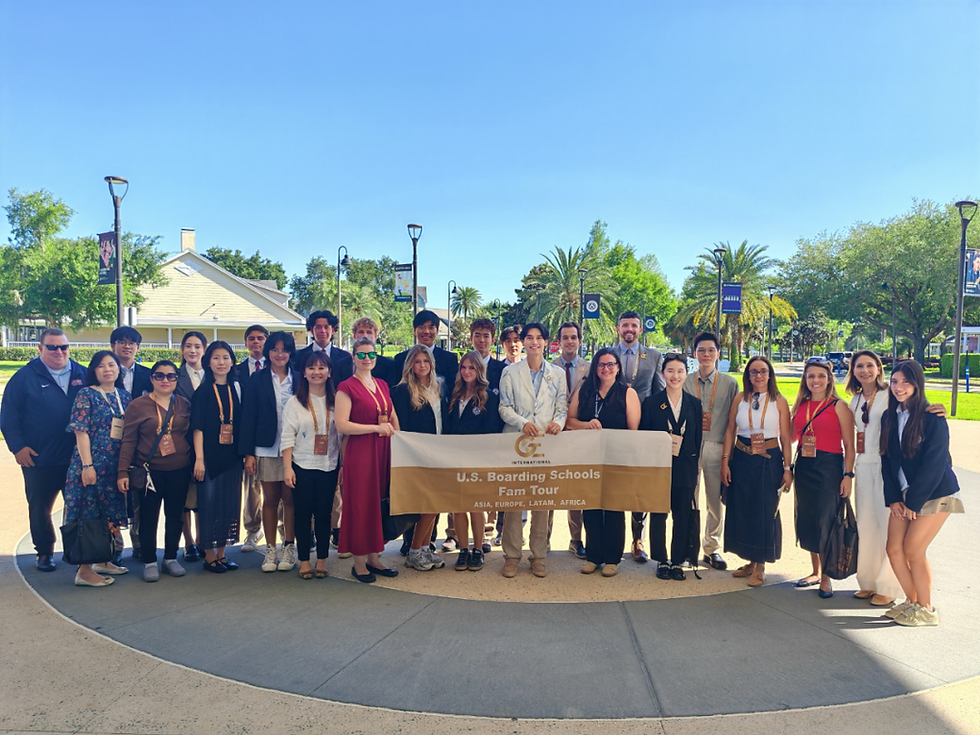
Today, the GE FAM Tour brought us to Santa Catalina School, often praised as “one of the most beautiful private high schools in California.” Located in the seaside town of Monterey, this all-girls boarding school impressed us with its deep artistic heritage, close-knit community, and outstanding academic support, offering a campus visit filled with warmth and depth.


The school is located in Monterey, a refined coastal town known as the “Language Capital of the World.” Spanning 36 acres, the campus has been named by *Architectural Digest* as “the most beautiful private high school in California.” The architecture is rich in history, with the main building, Hacienda, constructed in 1920. Many of its materials were imported from Europe, and even the front gate came from a Spanish castle. The campus was once home to artist Salvador Dalí, and an artistic spirit can be felt in every brick and tile.
The campus is fully enclosed with strict management, creating a safe and welcoming community where students can focus on learning while also enjoying Monterey’s vibrant art, music, and culinary culture.


Our GE FAM Trip team received a very warm welcome. All members of the admissions office attended the reception. The Head of School, Dr. Barbara Ostos, delivered the welcome remarks. She is currently in her fourth year as Head of School. Dr. Ostos holds a BA in Government and Romance Languages from Harvard University, an MA in Nonprofit Leadership and Management from the University of San Diego, and an EdD in Educational Leadership from the University of California, Santa Barbara. Before joining Santa Catalina School, she worked for 11 years at Catlin Gabel School in Portland, Oregon, and earlier served at her alma mater, Francis Parker School in San Diego. She began her career as a classroom teacher and later held senior administrative roles, including Assistant Head of School.
Santa Catalina School at a Glance
Santa Catalina School is coeducational and day-based from preschool through grade 8. Its high school program (grades 9–12) is an all-girls program, with a core mission of helping students live meaningful and purposeful lives.
* Approximately 60% of high school students are boarders, and 40% are day students
* International students make up about 25% of the student body, representing 14 countries and 10 U.S. states
* The school takes pride in its small community, ensuring that every faculty and staff member knows every high school student
* The average tenure of high school faculty and staff is 21 years
After gaining an overview of the school’s philosophy and structure, the visiting group moved on to the dormitories to learn more about boarding student life.


Student Dormitories
There are currently about 136 boarding students living across three dormitory buildings. Ninth- and tenth-grade students primarily live on the first floor, while eleventh- and twelfth-grade students live upstairs. Bathrooms are shared, with two bathrooms on each floor and about ten students sharing one bathroom. Thompson Hall and Hills Hall both have communal kitchens. Laundry rooms are available in the dorms for student use (students provide or purchase their own detergent). Campus-wide Wi-Fi is available 24/7 with content filtering, and all students are required to put away electronic devices after lights-out.
Dorms are open during the day. Students are expected to make their beds and keep floors and surfaces tidy. Staff regularly enter rooms for vacuuming and light cleaning. If a room repeatedly cannot be cleaned due to clutter, students may be required to participate in “work hours” to help build responsibility.
Dormitory Management
Evening study hours run from Sunday to Thursday, 7:30 PM to 9:30 PM. Weekday lights-out times are:
* Grade 9: 10:30 PM
* Grade 10: 10:45 PM
* Grades 11–12: 11:00 PM (quiet hours are required, but lights-out is not strictly enforced)
On weekends, lights-out times are:
* Grades 9–10: 10:00 PM
* Grades 11–12: 11:00 PM
Campus security is strict. The entire campus is enclosed by walls, with only one main entrance staffed by security guards. Dormitories remain locked until 2:00 PM, and no one may enter dorms at night. Leaving the dorm without permission at night, or failing to secure dorm doors, is considered one of the most serious rule violations. Students are not allowed to move freely around campus at night, including upperclassmen.

Roommate Assignments
Students may submit preferences when being assigned rooms, including preferred roommates or requests for single rooms. The school conducts two roommate changes each year. If a student was unable to room with their preferred choice in the previous round, the school will prioritize that request in the next adjustment when possible.


Faculty Housing
The school provides comprehensive housing for faculty and staff. Each dormitory includes approximately four to five faculty apartments. Across campus, there are about 25 residences in total, including family apartments and single housing. Some are located within the dormitory area, while others are across the street in a faculty residential zone. The Head of School’s residence is located along the road and is used primarily for hosting faculty, donors, and visiting parents. Each dormitory is staffed by four to five Dorm Parents on a rotating schedule, ensuring faculty presence every day.
The school also offers thoughtful support for student life and development. A campus shuttle runs regularly to Target, available on Friday evenings and throughout Saturdays, making shopping and outings convenient. In addition, the school offers a four-year “Journey Program” as part of college counseling, covering not only academic planning but also boarding life skills such as personal finance, supporting students’ growth both academically and personally.

To help students integrate more easily and practice English, Santa Catalina has made special arrangements. Students are not allowed to return to dorms during the day, and boarders and day students spend time together on campus. Teachers also interact with students in academic areas, offices, and the library. This encourages natural communication and faster integration into the community.
School Library
The twice-yearly roommate rotation is another distinctive feature, allowing students to get to know peers with different personalities and backgrounds. This helps broaden social circles, build genuine friendships among young women, and learn how to live with different people. The school aims to avoid cliques so that every student feels included and valued.
Performing Arts Center (PAC)
After visiting the dorms, we headed to the Carlota Performing Arts Center (PAC). The main theater seats about 500 people. Each year, the school stages three major productions for the entire community: two musicals and one play. There are also senior productions, two concerts, and a student-performed “talent show.” During our visit, students were rehearsing an all-female production of *Hamlet*, and their energy and focus left a strong impression.


Performing Arts Program
Santa Catalina’s performing arts program is highly professional and strongly encourages student ownership. Almost every aspect of production is student-run. Facilities include a full fly system that allows sets to be lowered from the ceiling, and backstage trailers used as dressing rooms. Through the Tech Leadership Program, students independently manage stage supervision, lighting, sound, backstage operations, costume repairs, and performance roles. Participation is very high: about 70% of students performed on stage last year, and when ushers and backstage support are included, overall participation reached 85%.
Each production typically involves about six weeks of rehearsal, or seven weeks including auditions. After school breaks, technical rehearsals begin on Tuesdays, with opening night on Friday. Due to the intensity of rehearsals, students are given three weeks of rest after each production concludes.
Dance Program
The dance program is extensive, offering nine different styles, including jazz, modern, hip-hop, ballet at various levels, lyrical dance, strength and flexibility training, yoga, and musical theater dance. The dance studio features a double-sprung floor and matches the size of the PAC stage, making it ideal for choreography and rehearsals. Dance can be taken as an academic elective or as part of after-school programs. Dance is offered across fall, winter, and spring seasons, with most courses in winter and four to six courses in both fall and spring.

Music Program
The music program is well-equipped and diverse, featuring six dedicated music studios for high-level private instruction. Courses cover about 14 instruments, including drums, ukulele, violin, and flute.


Thanks to Monterey’s rich cultural and artistic environment, the school collaborates with professional musicians to provide expert guidance and performance opportunities. Whether for personal interest or advanced skill development, the music program offers students an excellent platform to nurture their talents.
School Chapel

After visiting the PAC, the GE tour group went to the school chapel. The chapel is beautiful and serene, providing a quiet space for reflection. Boarding students attend Mass here on Sunday evenings, though religious belief is not required and participation is inclusive. After Mass, students enjoy a dinner prepared by a professional catering team at St. Peter’s Dining Hall.
In addition to Sundays, chapel gatherings are also held on Wednesdays, often themed around cultural holidays such as Easter, Diwali, or Ramadan. The school encourages students to set aside time for reflection and life contemplation, making the chapel a peaceful and inspiring space for personal growth beyond academics.
Academic Programs
The school arranged for students from diverse linguistic and cultural backgrounds to guide the visiting counselors. Our group was led by three students from China—one from Shanghai, one from Shenyang who is a member of the school basketball team, and one from Hangzhou.
Through their sharing, we could feel their genuine love for the school. They enjoy the environment and deeply appreciate the care and support provided by teachers. Student artwork is displayed throughout campus, the library was designed by an alumna, many teachers are also graduates of the school, and some even have children currently enrolled here.
We also experienced a marine ecology exhibition course. Thanks to its exceptional location, students have easy access to rich marine ecosystems for hands-on observation and experiments. They study theory in class and then explore coastlines, tide pools, and nearshore ecosystems, observing marine life up close. This immersive approach connects textbook knowledge with real-world observation, building research skills and environmental awareness.


We also met the head of the science department, who guided us through the robotics classroom.
STEM and Robotics
Santa Catalina’s STEM program is highly active, emphasizing hands-on practice and innovation. The school team has qualified for the Houston World’s Competition. The school also hosts a SWE Next Chapter, encouraging girls to engage in engineering and innovation.
The robotics team is particularly strong. According to faculty, the team is preparing for competitions in March and currently includes 24–25 students. The team has won the Imagery Award and the Sustainability Award.
The school offers “open shop hours,” allowing students nearly full-day access to spaces and tools for both personal interests and academic projects.
Sustainability is a major focus. Students are encouraged to reuse parts, avoid environmentally harmful materials, and primarily use aluminum and recyclable materials, integrating scientific innovation with environmental responsibility.


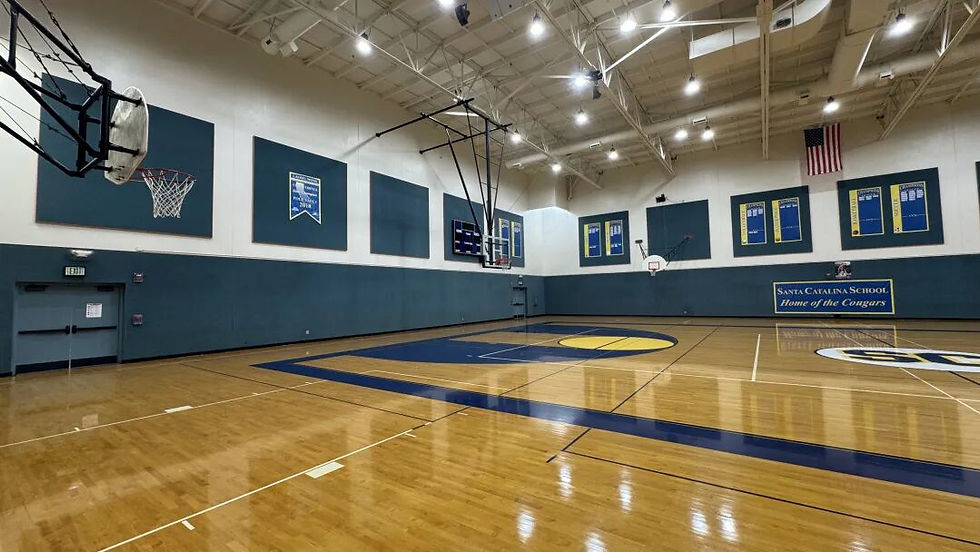
We then visited the athletic fields and met the Athletics Director, Ms. Kendra Klein, who guided us as we observed basketball and soccer practices.


Athletics and Extracurricular Activities
The school emphasizes holistic development. Over four years, each student is required to participate in activities across all three seasons—fall, winter, and spring—each year, totaling 12 activities. These include sports, performing arts, and dance. Activities typically run from 3:45 PM to 6:00 PM, and students can combine interests, such as drama with soccer, or performances with ceramics.
About 70% of students participate in athletics, and the school strongly encourages balancing arts and sports. Students may play a varsity sport one season, join a musical production the next, and then participate in robotics or Mock Trial in another season.


The performing arts clubs are equally diverse, including the Thespian Society, Improv Group, Dance Team, Lady Percussion Group, Band, and A Cappella Singing Group, offering many opportunities to showcase talent and explore interests.
The school strongly supports student-athletes and assists with college applications in multiple ways:
* Club waivers and arrangements: Competitive athletes may apply for waivers to train with external clubs, evaluated case by case
* Professional connections: The school helps connect students with local clubs and coaches
* Transportation and logistics: For students without local club options, the school coordinates transportation and training plans with families
* College recruitment support: The school assists students in connecting with college coaches
For example, a student from Indonesia who excels in fencing travels weekly to Cupertino for training due to the lack of local clubs, with transportation arranged jointly by her family and the school.
This comprehensive support allows student-athletes to excel both academically and athletically, strengthening their college applications.


The school features its own heated outdoor swimming pool, supporting year-round training and recreation. It is used for swimming and water polo, and the school’s water polo team has won state championships.
School Dining
After completing the campus tour, we returned to the admissions office for a discussion session. Members of the leadership team—including Katherine (Director of Student Affairs and Residential Life), Bo Covington (World Languages Teacher), Julie Edson (Upper School Head), and Ned (Academic Director and Engineering Department Head)—shared insights and answered questions about academics, boarding life, and programs, giving us a comprehensive understanding of the school.
School Insights
Key Strengths of International Students
The most successful international students are those willing to step outside their cultural comfort zones, actively make friends from around the world, and try new experiences. They are also proactive in building relationships with adults and integrating into the school’s social network. The warm, family-like environment values relationships, and students are expected to engage positively with peers and teachers.
Another major strength is the supportive community, where students cheer each other on rather than focusing solely on individual success. This positive peer culture helps students achieve their goals.
The school also encourages students to try new things in a safe environment, where imperfect attempts are not criticized. Through exploration, students discover their true interests and gain valuable skills.

Admissions and Academic Requirements
* The school currently enrolls 26 students from China
* This year’s intake includes 7 Chinese students in Grade 9 and 1 in Grade 10
* Average TOEFL scores for international students are above 100; the minimum requirement is 79, though most Chinese students score above 100
* SSAT scores are not required
The school offers strong academic programs to meet varying levels, including advanced math such as calculus in Grade 9 for qualified students. High TOEFL scores are crucial for international students’ academic success.
Home–School Communication
The school has a comprehensive communication system for international parents. Each advisor supports 6–9 students and meets with them regularly. Advisors communicate with parents via email and WeChat, sharing timely updates. Residential staff also provide boarding feedback during reporting periods, and the school publishes a weekly newsletter to keep families fully informed.

Santa Catalina School not only provides a solid academic foundation and rich arts and athletics resources, but also creates a safe, supportive, and challenging environment for growth. For girls who wish to explore themselves in a beautiful seaside town, love the arts, and embrace challenges, this may be the perfect place to begin their journey.

Comments