
What all boarding schools deliver, and what separates them.
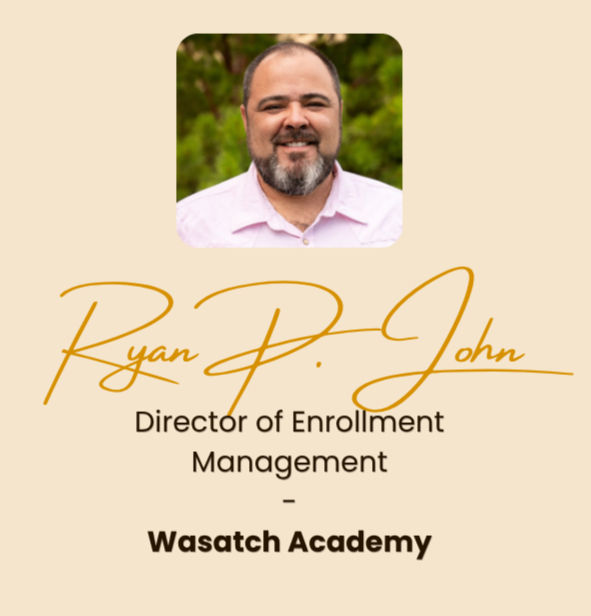
By Ryan P. John, Director of Enrollment Management
Wasatch Academy

As a parent or agent searching for the right educational opportunity abroad for your student, you’ve likely looked at schools with IB programs, A Program, AP courses, and traditional boarding or homestay options. You’ve weighed class sizes, coed vs. single-sex environments, matriculation lists, college placement rates, and asked endless questions. Where did you land? A boarding school. Why? Because every quality boarding school in America promises the exact same core benefits: a rich culture, a tight-knit community, small classes taught by subject experts, stellar college guidance, top-tier facilities, an active alumni network, and a rigorous curriculum.
So how do you narrow down your options?
Many parents or agents fall into the trap of simply asking, “Which one is ranked highest?” That is a dangerous approach. Rankings can be helpful, but they don't tell the whole story. They are arbitrary numbers based on hand-picked criteria that reflect what a publisher values, not what matters to your individual child: culture, offerings, and philosophical academic approach. To find the right match, you must look closely at your student's unique personality, desired outcomes, and the specific environment where they will thrive.
A school's philosophical approach to education is a critical component of narrowing several potential school fits into one, specific school match for a student. Some schools enforce a strict "core curriculum" where every student reads the exact same foundational texts. Others offer modular structures where you take one or two intensive classes for a few weeks, or operate on traditional semester models with fast-paced 8–10 week terms. None of these models is inherently better or worse, but they are vastly different. The most important question to ask is: "Which framework best supports my student's learning style?"
Crucial to this philosophy is the "Resource-to-Student" ratio. A school may advertise an incredible STEM program that catches your eye, but what ultimately matters is access. If your entering 9th grader loves advanced STEM, can they actually enroll in those courses straight away? Are there prerequisites, placement tests, or strict limits to entry? Is the program open or competitive, theoretical or hands-on? Fantastic programs mean very little if your child cannot access them, so be sure to ask the questions that directly impact your student's day-to-day experience with programs that are important to creating the experience you’re looking for.
A strong match in school culture is equally paramount. A student who craves natural beauty, fresh air, and quiet safety may not thrive in a dense urban center. Conversely, a student energized by a city’s hustle, lights, and sounds could struggle in a remote, rural environment no matter how pristine it is. Similarly, a student driven by high-pressure competition won't flourish in a community that emphasizes self-discovery through trying new things. Each school exists at a different point on the spectrum of growth and learning, and somewhere on that spectrum is the ideal match for your student.
Finally, consider this vital distinction: Is the school a boarding school, or a BOARDING SCHOOL?
Some schools are day schools with a small boarding program attached, sometimes fewer than 100 boarders in a student body of over 1,000, or a dorm of a few dozen students in a school of hundreds. For international students, that experience is vastly different from a BOARDING SCHOOL, where residential life is the primary focus, not an afterthought. The latter generally encompasses robust study-hall options, extra help in evening office hours similar to what you’d see in college, evening programming and activities, and a student population with kids from dozens of countries and states.
By contrast a day-heavy school often has limited access to teachers outside of class, sometimes even restrictions on sports participation or other programming. When 75% or more of the student body boards, programming revolves around them. Students don't watch the majority of their friends disappear on weekends. Instead, they embark on recreational trips, build deep relationships with kids and faculty from the US and around the globe, and experience a fully active, round-the-clock community.
As with some of the other distinctions mentioned, this is not “right vs. wrong.” It's two different approaches to “boarding school,” and they are two important differences to consider. Each model creates a unique “social-rhythm” on campus that impacts culture. If your student wants to be immersed in the full community, and is re-energized by spending weekends doing activities with friends, then a boarding-heavy environment is desirable. If your student is hoping for quiet weekends with occasional homestays with friends, then a day-heavy environment might be the right match.
Even some of the most foundational aspects of a school community can be impacted by the two unique models. Consider meals: in one school, students might be in an environment where hundreds of kids are enjoying their meals together, while in the other, they might eat breakfast and dinner in a dorm or boarding house with a much smaller group. It’s important for you to know how your student’s experience would be impacted by each - making an informed decision based on your desired expectations, experiences, and outcomes is critical to finding the right match.
Rest assured, you will have plenty of fantastic options to send your student abroad for a valuable, enriching educational experience. To narrow down your choices from a list of good fits to the one right match, focus on your desired outcomes, the learning environment, and attainable program access. Whether you are a parent of a student, or an agent helping a family, an in-person visit to campuses is very helpful and informative—much of what makes a school special is seen, heard, and felt while walking the grounds, meeting faculty, and speaking directly with current students. If you can't visit then request virtual meetings with faculty, coaches, directors, and students in key programs of interest.
Taking these deliberate steps ensures you make a well-informed, intentional decision for the student’s future, it also helps you move from “fit” to the right match.
NOTE: If you'd like to hear the author discuss these residential education philosophies directly, check out this interview on the Why Boarding School Podcast with Ryan John.


Comments