
Beyond the Classroom (Part II): 11 U.S. private schools where internships are part of the curriculum

Two students can have the same grades and test scores and still tell very different stories on a college application. Often the difference comes from what happened outside the classroom: a semester working inside a hospital department, a pilot's license earned before graduation, or original research defended in front of faculty.
This is the second installment in our series profiling U.S. private schools with standout internship and experiential-learning programs. Part I featured ten schools. Here are eleven more.
Featured in this article:
Montverde Academy — Florida
North Broward Preparatory School — Florida
Randolph-Macon Academy — Virginia
The Village School — Texas
Trinity-Pawling School — New York
The King's Schools — Washington
Layton Christian Academy — Utah
Maumee Valley Country Day School — Ohio
The Calverton School — Maryland
Burr and Burton Academy — Vermont
Buffalo Seminary — New York
01. Montverde Academy, Florida

Founded in 1912 in the town of Montverde, Montverde Academy is a co-ed college-preparatory school with day enrollment from Pre-K3 through Grade 12 and boarding for grades 7–12 plus post-graduates. Its students come from more than 70 countries and regions.
Montverde doesn't run a formal off-campus internship program. Instead, its experiential model is built around the SAC Specialized Concentration Diploma: students choose a concentration in grade 9, take focused coursework, and in grade 12 complete and defend an Apex senior research project before faculty mentors. Credit-bearing student-assistant roles on campus function much like internships, and dual-enrollment partnerships with four universities, including the University of Florida, let students earn college credit early. The Head of School Leadership Institute and 25 hours of required community service each year round out the program.
Recent Apex projects include a student-built, solar-powered prototype for cleaning debris from waterways and research showing that cassava-derived materials absorb better than standard medical gauze.

02. North Broward Preparatory School, Florida
Established in 1957 in Coconut Creek, in South Florida's Broward County, North Broward Prep enrolls students from more than 50 countries.
Upper school students can join an entrepreneurship research track, where they build business plans and practice investor pitches with faculty mentors, or a four-year aerospace engineering concentration with its own flight-simulator lab. As part of the Nord Anglia Education network, the school folds MIT research challenges, Juilliard masterclasses, and study trips to Switzerland and Tanzania into the regular academic program. In senior year, an alumni mentorship program connects students with professionals and internship leads before they graduate.
STEAM students won a $10,000 Lexus Eco Challenge scholarship for an environmental project, and a student team raised $236,000 for the American Heart Association, one of the top totals in the country.

03. Randolph-Macon Academy, Virginia
Founded in 1892 in Front Royal, about 65 miles west of Washington, D.C., Randolph-Macon Academy (R-MA) is a co-ed boarding and day school with a military heritage, serving grades 8–12 plus post-graduates.
Aviation is the signature program. Students train on the school's own fleet of aircraft and can earn an FAA Private Pilot Certificate or a Part 107 commercial drone license before graduating. The multi-year Pre-Professional Pathways sequence ties together course selection, faculty mentorship, internships, and a grade 12 capstone, and a three-week January Term gives upperclassmen dedicated time for internships, independent research, or travel abroad.
Much of the hands-on learning happens on campus, in flight simulators and an innovation center supported by FAA funding. The drone program has secured $307,000 in FAA grants and around 65 scholarships, and one flight student scored in the top 2% of all FAA practical-exam candidates.

04. The Village School, Texas
Founded in 1966 in Houston's Energy Corridor, The Village School is a co-ed Pre-K–12 school offering day enrollment as well as five- and seven-day boarding.
Its Internship Program places students in grades 9–12 with partners like Cisco and Houston Methodist Hospital, where they take on real projects with real deadlines, much like regular employees. Two specialized diplomas, in Entrepreneurship and Pre-Medicine, build internships, industry mentors, pitch competitions, surgical shadowing, and a senior capstone directly into graduation requirements.
Through its network's collaborations with MIT and UNICEF, students can go from campus research all the way to global forums. Student ambassadors can even take the stage at the UN High-Level Political Forum in New York.
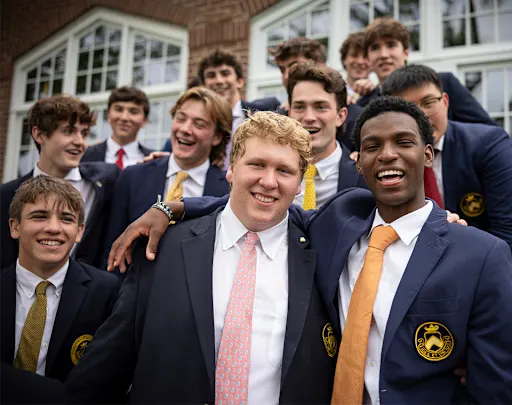
05. Trinity-Pawling School, New York
Founded in 1907 in Pawling, Trinity-Pawling is an all-boys boarding school for grades 7–12 plus post-graduates, enrolling about 275 students.
Every student must complete the Civic Leadership Practicum to graduate. Between Thanksgiving and Christmas, regular classes pause for a two-week Wintersession that builds year over year: maker-focused interdisciplinary projects in grades 7–10, group debates on global issues in grade 11, and an individual independent project in grade 12. Wintersession work earns academic credit and appears in its own section of the transcript, where college admissions officers can see it.
Four Saturday Active Learning Institutes cover Leadership, Civics, Entrepreneurship, and Environmental Stewardship, and a three-year science research program with the University at Albany (SUNY) carries university credit. The school doesn't arrange corporate internships centrally, but students can turn outside placements, such as work on a congressional campaign, into their senior project. Alumni have gone on to serve as a student senator at UC Berkeley and graduate as valedictorian at Trinity College.

06. The King's Schools, Washington
Established around 1950, The King's Schools is a Christian co-ed Pre-K–12 school on a 55-acre campus in Shoreline, just north of Seattle, with about 1,200 students.
Its standout offering is rare among U.S. high schools: on-campus internships with its parent organization, CRISTA Ministries. Juniors and seniors complete one-semester, credit-bearing placements in working departments such as radio broadcasting, international humanitarian relief, marketing, and legal services. Placements are selective, with clear goals, weekly reflections, and end-of-term evaluations. Students can also earn more than 30 college credits through dual-credit courses with Northwest University, compete in DECA, and join the FIRST Robotics team.
The robotics team has qualified for the FIRST World Championship every year since 2009 and once finished as runner-up. Graduates have gone on to Cornell, Duke, Brown, Columbia, MIT, and Yale.

07. Layton Christian Academy, Utah
Chartered in 1993, Layton Christian Academy is a Christian co-ed Pre-K–12 school offering five- and seven-day boarding. Its 600-plus students represent more than 53 countries, making it one of the most internationally diverse schools in Utah.
The focus here is early college access and hands-on projects. Seniors can take Weber State University dual-enrollment courses on campus for just $25 per credit, and students in grades 10–12 can write and defend a year-long independent research thesis through AP Capstone. Electives and clubs in aviation (with flight simulators), social media marketing, robotics, and science fair support career exploration.
The school reports a 98% graduation rate and 95% college acceptance, and students who attend for three or more years may qualify for in-state tuition at Utah's public universities.

08. Maumee Valley Country Day School, Ohio
Founded in 1884 in Toledo, Maumee Valley is a co-ed Pre-K–12 school. With the opening of Dayal House in 2013, it became one of the few independent schools in Ohio to offer boarding for international students.
Its signature is the Intensive Term: three separate three-week blocks each year when regular classes stop and every student focuses full-time on one thing, whether a campus project, domestic or international travel, or self-designed research or an internship. That adds up to nine immersive weeks a year, and about 70% of students travel abroad before graduating.
Internships run through the independent research pathway. Students find their own industry mentors and earn course credit with faculty guidance, on topics ranging from medical research to marketing. About a quarter of upper school students earn the Global Leadership Certificate, and the school runs medical service trips to Guatemala. Three students completed summer biomedical research with the University of Toledo, leading to two papers published in the university's medical journal.

09. The Calverton School, Maryland
Founded in 1967 in Huntingtown, about 45 minutes from Washington, D.C., The Calverton School is a co-ed Pre-K–12 college-prep school with around 345 students, offering day enrollment and five- and seven-day boarding in its One World Residence Village. It is the only high school in Calvert County that is an IB World candidate school.
Two graduation requirements anchor the program. Every senior completes a 40-hour internship during the final two weeks of the school year, along with the three core components of the IB Diploma: CAS (Creativity, Activity, Service), the 4,000-word Extended Essay, and Theory of Knowledge.
The school's location on the Chesapeake Bay shapes its science program. Students take a field ecology sequence from grades 9 to 11, and sophomores and juniors spend three days on an island research trip with the Chesapeake Bay Foundation. Recent graduates have been admitted to Duke, Stanford, Johns Hopkins, Carnegie Mellon, and William & Mary.

10. Burr and Burton Academy, Vermont
Established in 1829 in Manchester, about three hours from Boston, Burr and Burton is one of Vermont's oldest high schools. The co-ed college-prep school enrolls 700 to 800 students in grades 9–12, including international boarders.
Hands-on learning falls under its Integrative Learning program. Work-Based Learning, open to all students including international students, matches them with local employers. Other options include Farm Skills internships at Hildene, working in greenhouses and fields, and Kitchen Internships in a commercial kitchen that lead to ServSafe food-safety certification. Entrepreneurship courses pair with internships at local businesses and nonprofits and teach résumé writing and U.S.-style interviewing, while the Prep for Success course helps incoming students get ready to apply.
For international students, the international program office helps confirm what's permitted under F-1 visa rules, and college counselors fold internship records and supervisor recommendations into college applications.

11. Buffalo Seminary, New York
Founded in 1851 in Buffalo's historic Elmwood Village, Buffalo Seminary (SEM) is the sixth-oldest girls' school in the U.S. and the second-oldest in New York State. It serves 150 to 190 students in grades 9–12 plus post-graduates, both day and boarding, with a 1:5 student-faculty ratio and Harkness-style discussion classes. Its main building, dating from 1908, is on the National Register of Historic Places.
Internships are a graduation requirement: every senior completes a Senior Career Exploration placement. SEM maintains a curated database of placements across the city, including St. Joseph's Hospital, M&T Bank, art institutions, local newspapers, municipal courts, and nonprofits. What students produce during their internships, from research data to professional work, becomes the foundation of their Senior Capstone symposium and counts toward transcript credit.
Support is especially thorough for international students. A coordinator confirms F-1-compliant hours, pre-internship workshops cover workplace English, résumés, and interviews, and each student has both a faculty advisor and an on-site supervisor, who provide formal evaluations and recommendation letters. Transportation is arranged, and students with strengths in art, biology, or business can join the SEMFlex track for longer internship schedules without missing class.
What these eleven schools show, alongside the ten in Part I, is that there's no single model for experiential learning. Some build it around flight hours and certifications, others around internships written into graduation requirements, and others around weeks set aside each year for immersive work. For families evaluating boarding and day schools in the U.S., the right fit depends on how a student learns best and where they want to go next.
At GE International, this is exactly the kind of insight we work to surface for our partner schools and agents every day, built on years of relationships with the institutions doing this work well. If you're a school or agency looking to be part of a network built on trust, real placements, and results, not just rankings, we'd love to have you with us. Reach out to marketing@geinternational.org to learn more about joining the GE International community.


Comments